Words
“Idolatry” is when we prefer the symbols of religion to the facts of life. The “profane” is when we hold life up to our imagination and conclude that it is life which is wanting.
You are welcome to share anything you find on this site. Please link back to jimrigby.org.
“Idolatry” is when we prefer the symbols of religion to the facts of life. The “profane” is when we hold life up to our imagination and conclude that it is life which is wanting.
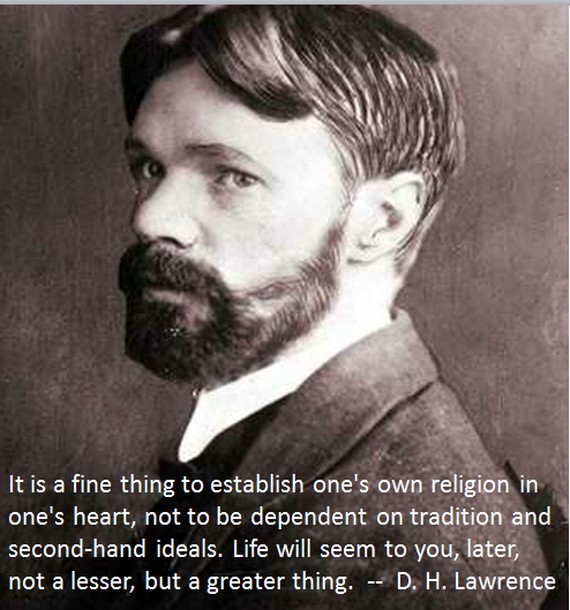 What does D.H. Lawrence mean by calling us to a religion of the heart? One possibility is that he is calling us to a private narcissitic religion. Obviously, he wouldn’t really need to call us to that kind of religion, its ranks are full.
I prefer to think he is calling us to an organic faith when he calls us to our own hearts. What people usually mean when they use the word “religion” is a very superficial thing compared to our untaught intuitions that we belong to nature, and to each other, and to a profound mystery we cannot even hope to understand.
As a minister, I obviously believe in organized religion. I believe such organization is necessary if we want to share our deepest life in community. But D.H. Lawrence is giving us a very important warning that organized religion is the lamp and never the flame. When religion asks us to be untrue to our own hearts, we must refuse. True religion may ask us to say “no” to our wants, but it never asks us to say “no” to life.
(Picture found on Juan Cole’s Informed Comment site.)
We had a strange sunrise this morning. It was hazy and pink. The strange color and blurriness brought back faint memories of a photo from years back. It took me a while to remember, but I recalled that strange photograph from one of Saturn’s moons by the European Space Agency.
This remarkable moment had almost slipped my memory when the Huygen spacecraft looked out briefly at what looks like an ordinary landscape millions of miles away.
What we cannot see in the photo is that the atmosphere consists of nitrogen and methane which washes the picture with an orange light. Whatever looks like ordinary rocks may be liquid or gas on our planet.
Artists have made pictures of methane lakes and other strange possibilities on Saturn’s largest moon. I love these images of far away moons and planets. But as lovely as they are, they are also a reminder of how delicate is the balance required for humans to survive and how urgent the need to care for our own planet.
A newly released documentary called “The Invisible War” claims that 500,000 rapes have occurred in the U.S. military since WW2. (link below)
According to SAPRO (Sexual Assault Prevention and Response Office) in 2010, 3,158 sexual assaults were reported within the US military. Only 529 of those reached trial and of those only 104 resulted in convictions. The report goes on to estimate that 19,000 cases weren’t even reported.
The Department of Veterans Affairs has estimated that one in three women in the military will suffer through some level of sexual assault. The military continues to deal with the problem in house even knowing that doing so puts pressure on victims not to report.
Lucy Broadbent of the Guardian UK wrote in an article December of last year on this problem. She reported, not only will the rapist go unpunished,“Worse still, the victim is likely to be blackballed by her own unit, and sometimes even demoted, according to Weber. “I first tried reporting the rape to my staff sergeant, he told me to be quiet and not tell anyone. So then I tried to tell a woman sergeant, who was beneath him, because I thought she’d be more sympathetic. She just cursed me for jumping the chain of command and not coming to her first. I went to the doctor, who did at least make a record of it, but he did nothing. I also told my ‘battle buddy’, a fellow female soldier. She said, ‘I know that guy. He’s married and he would never do such a thing. You’re a liar and a slut.’ Before long, I was being called a whore and a bitch by everyone. The guys were warning each other: ‘This one will accuse you of rape, so stay away from her.’ I was 18 years old, it was the first time I had ever been away from home. I had no idea what to do.”
The article concluded: “A female soldier in Iraq was more likely to be attacked by a fellow soldier than killed by enemy fire.”
No one who works with sexual assault will be surprised by this epidemic. Systems of domination breed abuse. Perhaps this is what the prophets meant when they warned that arrogant unchecked power poisons a nation. Perhaps a nation has this in common with the human body, that if our defenses grow too strong, we die of them and not from what threatens us from the outside.
“The Invisible War” clip: http://033e9e2.netsolhost.com/drupal/
Guardian Article: http://www.guardian.co.uk/society/2011/dec/09/rape-us-military
Conclusion: The Most Dangerous Fundamentalist in America
We come now to the end of our series on defending ourselves from fundamentalism. Today’s lesson is perhaps the most important, and that is how to spot the most dangerous fundamentalist of them all.
It is fairly easy to see when others are being fundamentalists. The problem is that fundamentalism is contagious. We pick up the same traits and don’t even realize it. As we saw in the first essay, fundamentalism is our human survival instincts, so, all of us fall in and out of fundamentalism. We humans often don’t feel our emotions, but instead see a world defined by anger or fear. So the most dangerous fundamentalist in your life, may live in the mirror
Our task today is to learn how to catch ourselves when we are slipping into fundamentalism. So here goes. I know I am being fundamentalist when:
I reduce the world to a melodramatic struggle between heroes and villains. In real life our roles are never that clear. When I cannot feel my own mixed motives, when I feel like I or my group is humanity’s last hope against some apocalyptic evil, it is usually I who has become a fundamentalist.
I think in polarized categories of black and white. When life seems dangerous or frustrating, I am tempted to simplify my mental map. I will ask either/or questions to reduce the information to bite size bits. To myself, I will feel like Socrates bringing razor sharp clarity to the confused and muddled idiots around me, but in truth I am turning off my color vision and reducing the world to a binary clarity never found in the real world.
When I believe the past was better than the future. Fear of modernity is a central part of fundamentalism. But time does not have a reverse gear so we must say yes to change. We are officially old on the day we hear a popular song and mutter, “that’s not music.” We are officially fundamentalist when we believe the ancients had all the good ideas.
When I use any scapegoat to organize my worldview. There is a difference between critical thinking and just being critical. If I have used anger at Bush or Obama as an organizing principle, I am probably being fundamentalist.
When I think that labeling a group of people is understanding them. We need labels to think, but no living being can be understood objectively, why? Because a living being is not an object. So whenever I think calling someone a “liberal”, a “conservative”, or even a “fundamentalist” has negated their argument, I am probably being fundamentalist.
When I think my group is right by definition. We all know people who think that their country is always right because they were born in it, and that their religion must be God’s favorite because they belong. Fundamentalism is so tricky that we can join a group specifically to fight against it, and end up doing all things described the above. Fundamentalism is the most contagious disease of all, because it lies in our tissue. Being spiritual is refusing to believe the world as described above. So, even this little series on fundamentalism is fundamentalist, if we ever forget that, in the words of Fireside Theatre, “We’re all bozos on this bus.”
Self Defense from a Fundamentalist Attack
12 Scriptures No Fundamentalist Believes
“Whatever is true”
I was once on a plane reading a Buddhist text. The woman sitting next to me leaned over and asked me what was wrong with Jesus. When I asked her what she meant, she said if I was reading another religion I must have found Christianity lacking. Her position was that the Bible is the only book a Christian needs to read.
Like many Christians she had the mistaken idea that the Bible contains all the truths a person needs to live a good life. The list of official scriptures is called a “canon” which comes for the word for yardstick. A ‘canon” is like a blood sample. The doctor doesn’t take all your blood, just a large enough sample to know what the rest of it is like. The Bible is like a sampler platter of old revelations that helps us know what truth will look like when we see it in new forms.
As Paul approached the end of his ministry, he left a very strange charge to the early church: “Finally, brothers and sisters, whatever is true, whatever is noble, whatever is right, whatever is pure, whatever is lovely, whatever is admirable–if anything is excellent or praiseworthy–think about such things.” Let’s break the passage down a bit:
First Paul says we are to think about whatever is true. This means we have not only permission, but a responsibility to outgrow the scientific worldview of the Bible. Jesus apparently believed that the mustard seed is the smallest seed. Even the hardiest fundamentalist would not give that answer on a botany test. We’ve learned new things about the world. Another place in scripture claims that rabbits chew cud. When Galileo discovered that the earth is not the center of the solar system the fundamentalists claimed he was attacking the Bible. Galileo defended his work by saying that the Bible is about how to go to heaven not about how the heavens go. Paul is telling us when we learn new things about the world, “faith” does not mean pretending biblical science still works, but seeking out whatever is true.
Then Paul says we are to think about whatever is good. Thank God most of us have stopped doing science using scripture, but it is even worse to use the Bible to replace doing ethics. Ethics requires that we adjust the rules to fit the real situations people are in. The Bible was written in a world before the abolition of slavery was thought possible. So the Bible tells enslaved people to obey their masters. Looking back we can clearly see the spirit of scripture was always calling to a freedom and universality that the letter of scripture had not yet obtained. Today no one uses scripture to justify slavery, but there was a time when many of the tracts defending slavery in the United States were written by literalistic clergy. Scripture says if a bride is found to not be a virgin on her wedding night she is to be stoned on her father’s doorsteps. Even a restaurant requiring shirt and shoes does not require a legless person to bring shoes to get in. So Paul is saying when human need is not served by a narrow understanding of the Bible, we do not need to pretend that Scripture can replace a human heart, we need to seek out whatever is good.
Finally, Paul says we are to think about whatever is beautiful. The church has often been a center of censorship and shame. We have been told that certain feelings are bad, and that art should be controlled by the moralists. Art requires a freedom of spirit beyond societal control. Too many churches let the candle of creativity get snuffed out by damp moralism, which is perhaps why the one time Europe was completely controlled by the church is remembered as the dark ages. Paul is calling us out of that artless lifestyle and saying the church should not tell us what to feel but should call us to seek out whatever is beautiful.
Today’s scripture to seek out whatever is true, good and beautiful gives the church permission to stop pretending we don’t know what we know or that we don’t feel what we feel. If the church had listened to Paul, we never would havestarted pretending in the first place.
Self Defense from a Fundmentalist Attack
12 Scriptures No Fundamentalist Believes
(Part 10 “Judge Not”)
The religion of fundamentalism requires a scapegoat. There must be someone to criticize or convert for the theology to work. So, if you want to make some people angry, just bring up Jesus’ command against judging.
Robert Meyer of “Renew America” put it like this, “The very idea that all judging is wrong, is an illegitimate synthesis between Christianity, moral relativism, and the contemporary perspective on “tolerance.” These ideas have been wedded together to conjure up (a) witch’s brew of self-contradictory sophistry.”
Fundamentalism often emerges in times of cultural disintegration. It is not hard to sympathize with people trying to hold their communities and families together by putting the world into simple categories that give a sense of understanding and direction.
Often the concerns fundamentalists have are legitimate, but such over simplification can be deadly for those who end up in the role of scapegoat. Fundamentalists are correct in saying we need some kind of discernment. We must make judgments when it comes to ideas and actions, so what was Jesus trying to say when he told us not to judge? (“Do not judge, or you too will be judged. For in the same way you judge others, you will be judged, and with the measure you use, it will be measured to you. “ (Matt 7.1-3 NIV))
Many religious misunderstandings boil down to undefined terms. People use the same words in different theological systems and it easy to feel that others are twisting the text. I agree with fundamentalists that we do have decisions to make. There are bad actions and bad ideas. The command not to judge cannot mean to ignore contradictions in an argument, or injustice in an action. So what does the command against judging mean? Here are a several guesses:
It is a command against arrogance.
Whatever “judging” means it begins when any of us think that we represent the model for the rest of us. The fundamentalist presumes an elevated vantage point from which to point out the shortcomings of others. When a group of moralists had gathered with their scripture to stone a woman caught in adultery, they were absolutely correct that the scripture said to stone her. They would say they were not judging the woman just obeying scripture, but Jesus said “whoever is perfect throw the first stone.” Some fundamentalists will quickly point out that Jesus told the woman to “sin no more.” It is true that is what he said to her, but what he said to the rest of us, is to lay down our stones.
It is a command against bullying.
If we ask a fundamentalist to leave other people alone, they will sometimes say we are the ones judging and that they are the real victims, but “judging” isn’t just an opinion. It is interfering in the lives of others. And, just because someone can find a verse in the Bible does not mean they have been given the authority to say what that means in someone else’s situation. Bullies often say they are trying to control us because they love us, but no one can love anyone they do not first respect.
It is a command against revenge disguised as justice.
There are some people who are only good to avoid punishment. Such people cannot sleep knowing that others are getting away with pleasures which they themselves find tempting. When they say “I love the sinner but hate the sin” it is not very hard to discern the velvet cloaked dagger of resentment in their moralizing.
So what was Jesus saying? Christianity is called “the new covenant” because it was not based on obedience to the law. Jesus saw the sins of the world as wounds rather than infractions to be punished. So he said, “judge not and you will not be judged.” The new covenant was an offer of clemency for all who would offer that same clemency to others.
The new covenant requires no scapegoats for its theology to work. Quite the opposite it requires us to be willing to present ourselves as living sacrafices. We must be willing to suffer rather than inflict suffering because we understand a very important fact about our world. Namely, that we cannot eliminate the wounds of the world by punishment. We can only remove these wounds by healing them.
Self Defense from a Fundamentalist Attack
12 Scriptures No Fundamentalist Believes
(Part 9 “Jubilee”)
In our nation, fundamentalism almost always favors conservative economic policies. Charity is praised, but those who would challenge the conditions that produce poverty are viewed as contaminating the pure message of Jesus with liberal politics. Martin Luther Kings preached about the Good Samaritan saying that, at some point, it is not enough to patch up the wounded traveler. At some point, he claimed, we need to make the road to Jericho itself safe. But did Dr. King understand Jesus or was he mixing his own politics into the story?
When Jesus began his ministry, he said he had come to preach good news to the poor, and to declare the acceptable day of God. Jesus’ listeners would recognize that he was declaring the time of Jubilee. Jubilee (found in Lev.25) was a longing people had for justice. At the time of Jubilee prisoners were to be released. Economic disparities were to be addressed by a redistribution of the wealth so all had enough.
If we look at the Fourth Commandment as it is presented in Deuteronomy, it is clearly a “little Jubilee.” On that day we are not to work, but neither are our servants, or migrants or animals. The Sabbath was not just a religious celebration., in fact, if you look carefully, there is nothing about worship in that commandment! Instead, the Sabbath is a day for healing each other and the land. As James says, such mercy is the worship most pleasing to God.
I do not believe we can say that Jesus was conservative or liberal, but it would be a strange thing to believe that Christ calls us to help the poor and then choose a form of politics that codifies their poverty. It would be a strange thing to say Christ calls us to feed the hungry and then cut school lunch programs, punishing children for what we perceive as laziness in their parents.
Some fundamentalists earnestly believe that a social safety net makes people lazy. But let me ask you this. Did it make you lazy to have your parents guarantee a roof over your head, and to promise you would have enough food to eat? Did that care make you lazy, or did it make you feel secure enough to go after higher goals than mere survival? If we say that what made us feel worthy would make others lazy, is it is possible that we believe ourselves to be superior?
I do not believe that the teachings of Jesus should ever be reduced to nothing more than a social justice message. But I also believe it should not be made less than that either. It is a strange thing to say we believe in Jesus, and then choose a political system that would make impossible the world to which he calls us.
Self Defense from a Fundamentalist Attack
12 Scriptures No Fundamentalist Believes
(Part 8 “Let us leave the elementary teachings”)
Fundamentalism teaches that scripture is to be understood at the literal level, and that all scripture is inspired at the same level. When we see texts that seem immature, cruel, or just wrong, fundamentalism tells us to close our hearts and minds and obey scripture as if it were literal instructions from God.
Today we are looking at a place where Paul admits that some of his earlier teachings were scaled down because of the immaturity of his listeners. “I gave you milk to drink, not solid food, because you weren’t ready for it.” Paul is saying his earlier teachings were put in an immature form and now he wants the church to grow up. He says in Hebrews, “Therefore let us leave the elementary teachings about Christ and go on to maturity, not laying again the foundation of repentance from acts that lead to death, and of faith in God,”
Amazing! Paul is telling us to outgrow what he has taught us!
Fundamentals are like the roots of a plant. They are the foundation, but they are not the “point.” The plant is fulfilled by its fruit not by its root. So religion must begin simple enough for children without trapping us at that level. In fact, Jesus compared his own teaching to seeds. The seed is set of instructions, but also a catalyst that begins a chain reaction of growth in the soil. The seed dies in the soil and the plant is born. Literalism is like trying to eat the seeds.
So Paul tells us to “grow up,” but grow up into what? Corinthians makes it clear that all religion is to aim at love. “When I was a child, thought as a child, I reasoned as a child, but when I became an adult I put aside my childish ways. “ Paul says the law was a kind of babysitter given until we could grow up and take responsibility. “Therefore the Law was our tutor to lead us to Christ, so that we may be justified by faith. But now that faith has come, we are no longer under a tutor.”
Paul further says the law is only a reflection of what God is calling us to, which is love. “The old system under the law of Moses was only a shadow, a dim preview of the good things to come, not the good things themselves.” In other words, it’s okay to outgrow what we have been taught. In fact, Paul is frustrated with people who keep returning to the basics when it is time to let go of fundamentalism and grow up into love.